The Rock Climber's Training Manual by Michael L. Anderson PhD and Mark Anderson Review (2026)
Updated September 14, 2026 · Research-based review
Our verdict
The Rock Climber's Training Manual by Michael and Mark Anderson lays out the Rock Prodigy Method, a periodization plan the authors built and used on their own hard trad and sport projects. It rewards climbers willing to follow a detailed program, though its dense structure can overwhelm someone who just wants a few gym workouts.
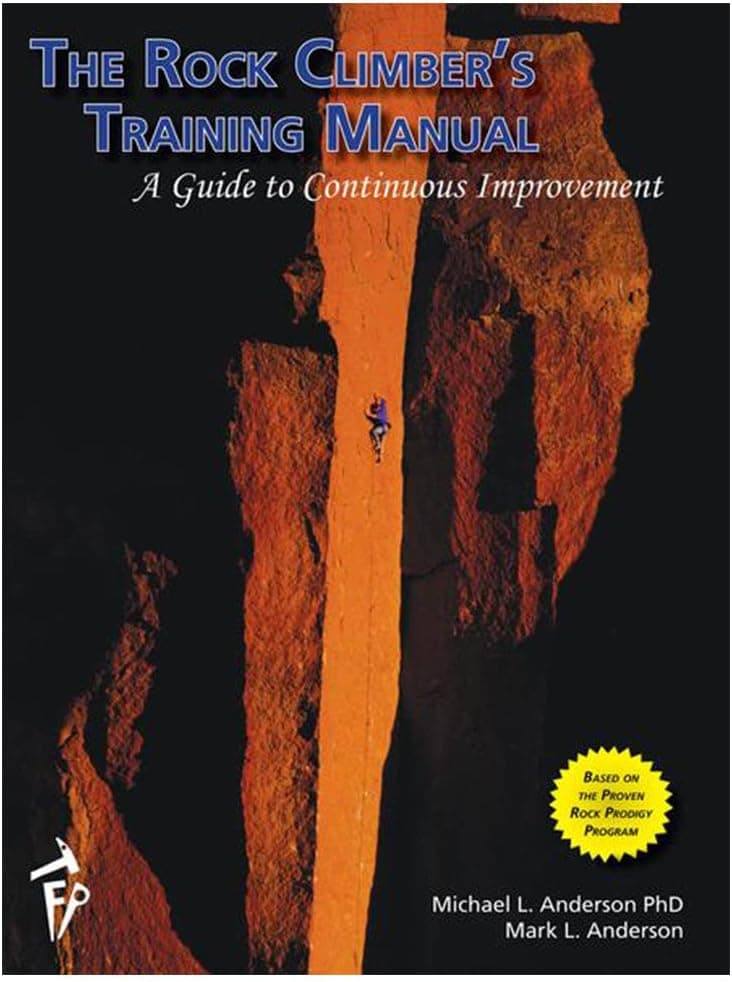
The Rock Climber's Training Manual by Michael and Mark Anderson, a structured periodization guide for committed sport climbers.
Price range: See on Amazon
What we liked
- + Lays out season-long training phases instead of random workouts
- + Written by climbers who used the system on their own hard projects
- + Detailed hangboard and campus protocols suit data-minded trainers
Trade-offs
- - Dense, program-heavy approach can overwhelm casual gym climbers
- - Assumes access to a home board or well-equipped training space
What this book covers
The Rock Climber's Training Manual, written by Michael L. Anderson and Mark Anderson and published by Fixed Pin Publishing in 2014, lays out what the authors call the Rock Prodigy Method, a periodized training system built around distinct phases for base fitness, maximum strength, power and power endurance rather than a loose collection of unrelated workouts. Running 301 pages, the book walks through the reasoning behind each training phase alongside concrete protocols for hangboarding, campus boarding and structured climbing sessions, aimed at climbers who want to plan an entire training season rather than just show up and try hard at the next session.
The Rock Prodigy periodization structure
Periodization, the book's central idea, means cycling through phases with different training goals over weeks and months instead of doing the same style of session year round, a structure borrowed from general strength and endurance sports and adapted specifically for the demands of rock climbing. The Andersons built and refined this system on their own climbing, using it to work toward hard trad and sport projects of their own, which the book leans on as its credibility rather than claiming purely academic research. That real world testing shows up in the level of detail given to hangboard and campus board protocols, including specific rep and rest schemes rather than general guidance.
Who gets the most from following the program
Because the Rock Prodigy Method is built around a full periodized cycle, it rewards climbers who can commit to following the plan over weeks or months and who have access to a hangboard, campus board or similar home training setup rather than only bouldering or top rope sessions at a commercial gym. Climbers used to picking up a training book for a handful of standalone workouts may find the phase-based structure more demanding to follow than expected, since skipping around the book without following the underlying periodization logic works against how the system is designed to function.
How it compares with other training books
Against Eric Horst's Training for Climbing, a broader reference covering physical, technical and mental training in less depth per topic, the Rock Climber's Training Manual goes deeper into a single periodized system rather than surveying a wider range of training approaches. Against more recent evidence-based titles that lean harder on published sports science citations, the Andersons' book leans more on their own applied experience refining the Rock Prodigy Method through their own climbing, which some readers find more practical and others wish came with more academic backing. Both approaches have earned strong reputations in the climbing training space for different reasons, and many long-time climbers end up owning both books, reaching for one or the other depending on whether they want a full structured cycle or a broader reference to dip into for a specific topic.
Who should buy this manual
This book suits climbers who already boulder or climb regularly, have some access to a hangboard or campus setup, and want a full structured program to follow rather than isolated tips, particularly trad and sport climbers eyeing a specific hard season goal the way the authors originally built the system for themselves. Climbers newer to structured training, or those without access to a home training setup, may find a broader, lower commitment book like Horst's Training for Climbing an easier starting point. Given our score of 8.6 out of 10, it remains one of the most respected structured training references in the sport.
Frequently asked questions
What training system does this book teach?
The Rock Prodigy Method, a periodized system with distinct phases for base fitness, maximum strength, power and power endurance rather than unstructured workouts.
How long is the book?
301 pages, published by Fixed Pin Publishing in 2014, written by Michael L. Anderson PhD and Mark Anderson.
Do I need a hangboard to use this program?
Access to a hangboard, campus board or similar home training setup is important, since the protocols are detailed and specific rather than general advice.
How does it compare with Eric Horst's Training for Climbing?
This book goes deeper into one periodized system, while Horst's book surveys physical, technical and mental training more broadly across a wider range of topics.
Prices change often, so check the current price and availability on Amazon.
Check price on AmazonClimbing Nest may earn a commission from the link above.